01 · Security principles
Layered security by design
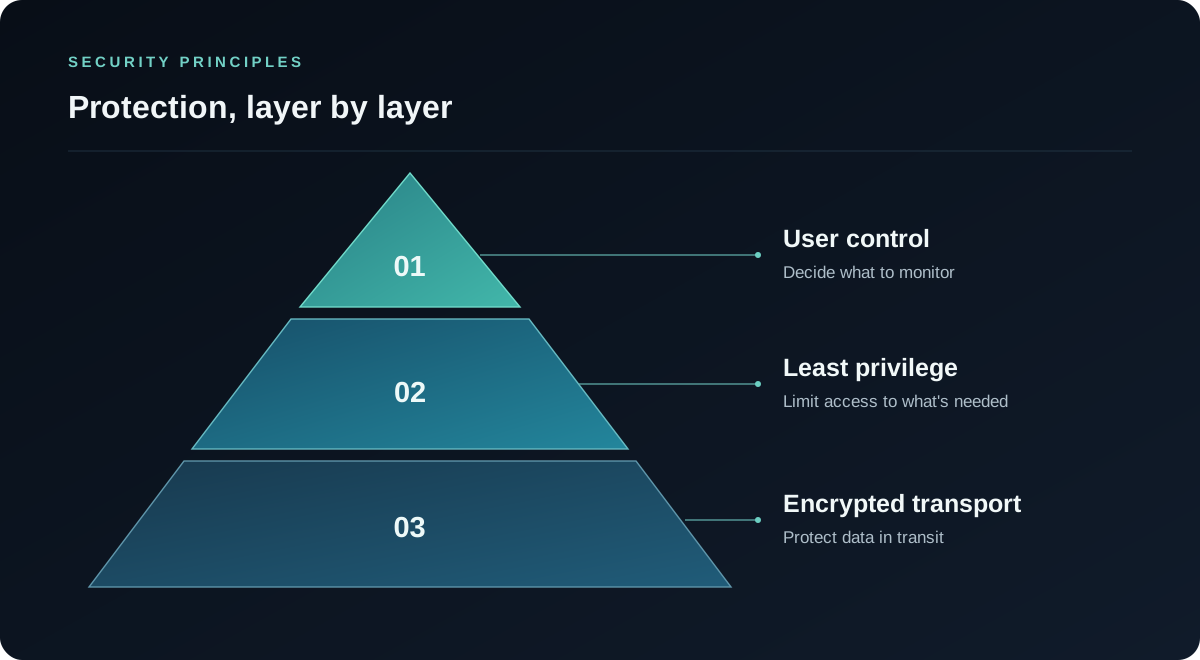
OpsHome NOC is designed for homelabs, self-hosted services, and small infrastructure environments. Its security model combines encrypted transport, least-privilege access, protected private-network boundaries, user-controlled monitoring scope, and verifiable software releases.
OpsHome NOC is independently developed proprietary software with publicly documented security boundaries and verifiable release evidence.
02 · Connection boundaries
Private infrastructure stays behind your network boundary
OpsHome clients and Docker Probe communicate with the service over encrypted HTTPS connections. The public service uses strict transport controls and a protected origin boundary; requests that attempt to bypass the protected service edge are blocked.
Docker Probe runs inside a network authorized by the user and initiates outbound connections. Normal operation does not require inbound firewall ports, router port forwarding, or publication of an internal management interface.
Protected access surfaces
- Native clients
- Encrypted monitoring access with supported identity data protected by Apple Keychain Services.
- OpsHome Console
- Apple-authenticated, time-limited, read-only browser access with no infrastructure control.
- Docker Probe
- User-controlled outbound monitoring for private infrastructure without exposing an inbound management service.
03 · Docker Probe
Permissions follow the enabled monitoring features
Each monitoring capability uses only the permissions required for that feature. The requested access is shown before deployment and enabled by the user.
- The Probe reaches only monitoring targets authorized by the user.
- Host data paths are mounted read-only.
- No inbound service port is published.
- No remote shell, Docker Exec, or container-control feature is provided.
- No customer credential is embedded in the published image.
Application secrets, business-file contents, and data unrelated to monitoring are outside the OpsHome telemetry scope and are not retained or uploaded as monitoring records.
04 · Credential and communication protection
Sensitive information is separated from ordinary monitoring data
- Client and Probe traffic uses encrypted HTTPS connections.
- Probe communication uses authenticated requests with replay protection.
- Supported sensitive server-side credentials are encrypted before storage.
- Supported iOS authentication data is protected by Apple Keychain Services.
- Complete secrets are excluded from application logs.
Users should create dedicated, least-privilege accounts for infrastructure integrations whenever the connected platform supports them.
05 · Data handling
Monitoring records support history, incidents, and notifications
OpsHome NOC generates status, event, and trend records from monitoring tasks configured by the user to provide history, incident analysis, and notifications.
| Data category | Purpose | Public handling standard |
|---|---|---|
| Account identity | Sign in, account recognition, and access control. | Includes the Sign in with Apple identifier where used; retained while the account is active and protected by access controls. |
| Integration credentials and Probe tokens | Connect monitoring targets authorized by the user. | Protected at rest and available only to the service components required to perform the authorized connection. |
| Monitoring configuration | Store the targets and capabilities selected by the user. | Retained while the account is active or until the user removes the configuration. |
| Status and time-series metrics | Provide current status, trends, incident analysis, and notifications. | Limited to the history window included with the active plan and automatically removed when that window expires. |
| Non-monitoring business content | Not required to provide the monitoring service. | Outside telemetry scope Application secrets, business-file contents, and unrelated data are not retained or uploaded as monitoring records. |
After an account deletion request is confirmed, an automated deletion process starts immediately to remove the account and related service data. Signing out ends the current session and does not delete the account.
06 · Release integrity and verification
Published evidence is tied to an exact image
- Target
- opshome-probe:latest
- Scan status
- CLEAN
- Vulnerabilities
- 0 detected
- Scan date
- 2026-09-30
Image digestsha256:689dc3b46954b2fcf25362f2847e9fd11d9cd6bc55cc92c102ca775b6d1ba8c3
The automated scan of the corresponding OpsHome Probe Image found 0 known vulnerabilities. The published digest binds this result to the exact verified image.
Users can independently verify the image digest, published ports, read-only mounts, deployment permissions, and outbound connections.
tcpdump -i any host app.opshome.run -nn -A -c 5Independent security validation


07 · Shared responsibility and reporting
Security is shared across the service and local environment
OpsHome maintains the security controls of the product and cloud service. Users retain control over their local hosts, network policies, integration credentials, monitoring targets, and platform updates.
Report a security concern
Send the affected version, relevant context, and a safe reproduction description to support@opshome.run.